
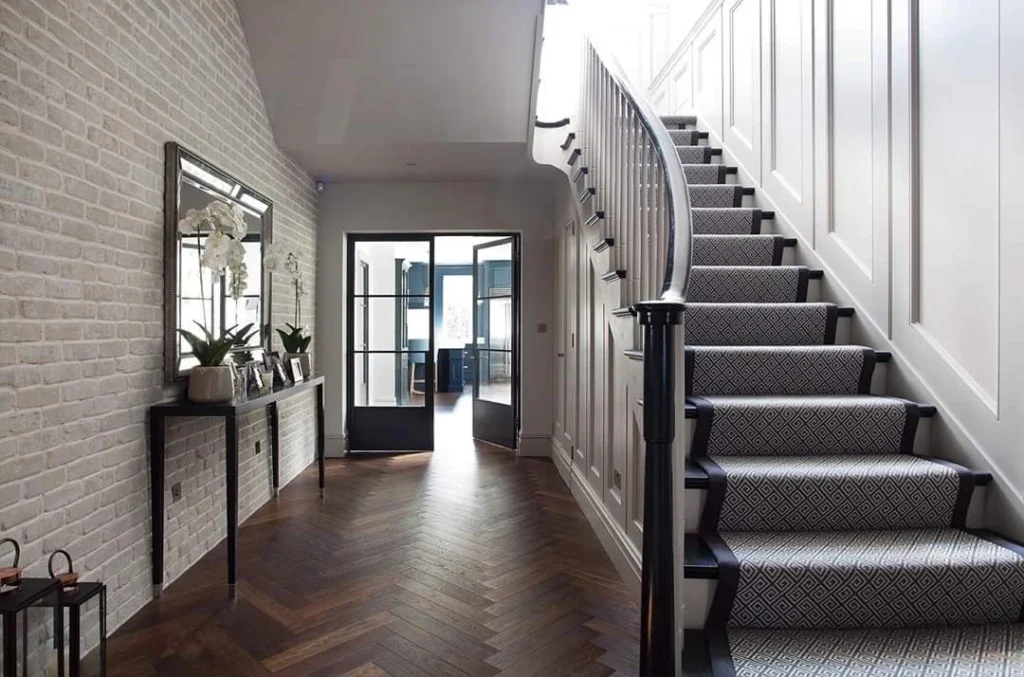
1. Introduction — What Is a Stair Runner & Why They’re Back in Irish Homes
Stair runners have become one of the most impactful design upgrades in Irish homes. A stair runner is simply a tailored strip of carpet with a finished edging, fitted through the centre of your staircase with the sides exposed. While the idea is simple, the visual effect is powerful — creating a clean, modern statement the moment you enter the home.
In 2026, homeowners and interior designers across Ireland are choosing stair runners primarily for their design impact. With endless combinations of materials, borders and colours, a runner can be styled to suit any interior — from contemporary and minimalist to classic and character-rich homes.
As a leading supplier of high-quality natural carpets, and with our own in-house binding production, Deco Designs creates some of the most refined stair runners in Ireland. We collaborate with interior designers on premium residential projects nationwide, delivering bespoke runners that combine craftsmanship, durability and style.
This guide explores the best stair runners in Ireland for 2026 — including design ideas, materials, borders, sizing, and the most common mistakes to avoid — so you can confidently create a stair runner that fits your home perfectly.
2.Best Carpet Materials for Stair Runners
1.Wool Stair Runners
Wool is one of the most reliable and versatile materials for stair runners. As a natural fibre, wool is naturally resilient — meaning it bounces back under daily impact, making it a smart choice for busy staircases. Its softness, warmth and forgiving nature make it especially popular in Irish homes, whether the style is modern, classic or somewhere in between.
Wool stair runners work beautifully with subtle patterns, herringbone designs, and elegant neutral modern stair runner styles. They also pair effortlessly with cotton, suede or leather borders for a refined finish.
Pros of Wool Stair Runners
- Soft and comfortable underfoot
- Naturally durable and long-lasting
- Excellent at absorbing noise on timber stairs
- Wide design range, from modern neutrals to textured weaves
- Naturally flame-resistant and hypoallergenic
- Flexible material that works on straight stairs, winders and landings
Cons of Wool Stair Runners
- Higher investment compared to synthetic alternatives
- Light-coloured wool may fade slightly with prolonged sunlight exposure
- Requires wool-safe cleaning products
- Not as architectural or rigid in appearance as sisal (for bold, structured looks)
Lifespan: Typically 10–15 years, depending on footfall and care.
Price Range: Mid–premium range depending on weave, density and border choice.
Explore our natural wool carpet collections
2.Sisal Stair Runners (Natural Plant Fibre)
Sisal is one of the most sought-after materials for modern stair runners. Made from durable, natural plant fibres, sisal offers a beautifully textured, architectural look that instantly elevates a staircase. It’s especially popular with interior designers who want a clean, contemporary aesthetic with strong visual impact.
Because sisal is naturally firm and structured, it creates a crisp, tailored runner — ideal for adding definition and shape to stairs and hallways. When paired with a contrast cotton or leather border, sisal becomes a true statement feature.
Pros of Sisal Stair Runners
- Extremely hard-wearing and durable — ideal for high-traffic staircases
- Distinctive natural texture suited to modern, neutral and contemporary stair runner styles
- Naturally anti-static and moth-resistant
- 100% natural material with a low environmental footprint
- Works beautifully with wide borders (50mm) for a clean, designer finish
- Perfect for creating herringbone stair runner looks and structured patterns
Cons of Sisal Stair Runners
- Firm underfoot — not as soft as wool
- Sensitive to spills and moisture
- Can show staining more easily than wool
- Clients wanting a cushioned feel may find sisal too rigid
- Requires an experienced supplier/installer due to its structured nature
About Jute Stair Runners
Jute is another natural plant fibre often considered by homeowners for its soft, relaxed texture. While jute carpets look beautiful, a jute stair runner is not recommended for most Irish homes. Jute is softer and less durable than sisal or wool, meaning it can wear quickly on stair edges and flatten under daily footfall.
If you love natural materials but need durability, sisal or wool is a far better option for stairs.
Explore our Sisal carpet collections
3.Sisal & Wool Mix Stair Runners
Sisal & wool blend carpets combine the best qualities of both natural fibres. You get the warm, comfortable feel of wool with the structured, textured appearance of sisal — resulting in a beautifully balanced stair runner that suits both contemporary and classic interiors.
These blends are ideal for clients who love the natural texture of sisal but want something slightly softer and more forgiving on stairs.
Pros of Sisal & Wool Mix Stair Runners
- Combines sisal’s durability with wool’s softness
- Balanced texture — less coarse than pure sisal
- Naturally anti-static and low in VOCs
- More refined and versatile than raw plant fibres alone
- Works well with borders for a clean, contemporary finish
- Suits a wide range of interiors — from modern to traditional
Cons of Sisal & Wool Mix Stair Runners
- Slightly less durable than 100% sisal in very high-traffic areas
- Still somewhat sensitive to spills due to sisal content
- Typically higher price point than standard wool or sisal
- Not as soft as pure wool, not as rigid as pure sisal — sits in the middle
Lifespan: Typically 7–12 years depending on blend ratio, foot traffic and care.
Price Range: Upper mid–premium, depending on weave type and quality of fibres used.
Explore our Sisal & Wool Mix carpet collections
4.Recycled & Washable Stair Runners (PET, Recycled Nylon)
Recycled fibre carpets — often made from recycled PET bottles or regenerated nylon — offer a more eco-conscious alternative to traditional synthetic options. While not as widely used for luxury stair runners, some recycled flatweave styles can work on stairs, especially in homes looking for a practical, easy-care solution.
Pros of Recycled/Washable Stair Runners
- Made from post-consumer recycled materials (PET, nylon, polyester)
- More sustainable than virgin synthetics
- Highly stain-resistant and easy to maintain
- Available in a wide range of colours and patterns
Cons of Recycled/Washable Stair Runners
- Less natural underfoot feel compared to wool or sisal
- Not biodegradable
- Aesthetically less premium than natural fibres
- Limited availability in stair-runner-suitable weaves
Best Use – Ideal for clients who value practicality, stain-resistance and sustainability — but prioritising design-led luxury usually leads homeowners back to wool or sisal.
Explore our Washable carpet collections
3.Edging, Borders & Finishes (A Simple Overview)
A border is the finishing detail that frames a stair runner and defines its overall look. Some designs use a subtle, tone-on-tone finish, while others make a statement through contrast, colour or texture. At Deco Designs, we offer a curated range of edging materials to suit modern, classic and contemporary interiors.
Available Border & Binding Materials
Wool Binding – A narrow, minimal edging designed to blend with the carpet. Soft, subtle and almost invisible, ideal when the runner itself is the main visual feature.
Herringbone Cotton Border – Our most popular choice, available in two widths: 25mm and 50mm. Clean, modern and versatile, with a refined woven texture suited to both contemporary and traditional homes.
Faux Suede – A soft, premium border made from 100% polyester, offering an elegant, luxurious finish — perfect for wool and flatweave stair runners.
Faux Leather – A bold, structured and contemporary edge made from 100% polyester. Ideal for creating sharper definition and a more architectural look.
Stripe Borders – A playful, modern decorative option made from recycled polyester. Adds personality and graphic detail without overpowering the overall runner design.
Outdoor (OT) Borders – Highly durable and practical, made from recycled polyester. Available in a wide range of modern colours and an excellent pairing for natural textures such as sisal.
Explore our full Binding collections
4. Styles That Work Best in Irish Homes (2026 Trends)
1.Herringbone Stair Runners
The herringbone stair runner continues to be one of the most sought-after styles in Irish homes for 2026. Its subtle woven pattern adds movement and texture without overwhelming the space, making it suitable for everything from modern new builds to classic period properties.
Herringbone works particularly well in Irish entrance halls, where the staircase is often one of the first architectural elements you see. The pattern creates visual interest while remaining elegant and timeless — a perfect balance for design-conscious homeowners and interior designers.
Why Herringbone Works So Well
- Adds gentle pattern without visual clutter
- Complements both light and dark timber stairs
- Works with a wide range of border options (25mm or 50mm)
- Ideal for Scandinavian, contemporary and transitional interiors
- Long-lasting design that never feels dated
If you want a safe, stylish and timeless choice, herringbone is consistently one of the most reliable stair runner designs.
Material Pairings
Herringbone patterns are most commonly found in flatweave and wool constructions.
They pair beautifully with cotton borders — especially in subtle tones like charcoal, stone, tan or soft ivory.
Explore our herringbone & geometric carpet collection
2.Modern Stair Runners
Modern stair runners are all about clean lines, subtle textures and a refined, understated aesthetic. In Irish homes today—especially new builds and renovated period properties—modern runners create a calm, elegant flow from the hallway upward, acting almost like a soft architectural feature.
This style avoids heavy patterns, instead focusing on simplicity, balance and high-quality natural materials. When paired with the right border, modern stair runners can transform a staircase into a minimalist yet luxurious design statement.
Why Modern Runners Are Popular in Ireland (2026)
- Suit both new builds and contemporary renovations
- Create a bright, seamless look in entrance halls
- Pair beautifully with neutral tones and timber stairs
- Work exceptionally well in open-plan layouts
- Provide a sophisticated, timeless base for any décor style
A modern runner is ideal for homeowners who want style without visual clutter — understated luxury that elevates the entire home.
Material & Colour Choices
Modern styles most commonly use:
- Flatweave carpets for a crisp, tailored finish
- Wool in neutral tones (oat, stone, ivory, charcoal)
- Sisal blends for subtle natural texture
Borders that work best with modern runners include:
- 25mm cotton for a clean, minimal edge
- 50mm cotton in tonal shades for a soft contrast
- Faux leather for a sharper, more architectural line
Explore our full carpet collection
3.Timeless Stair Runners
Timeless stair runners are designed to look beautiful today and for many years to come. They focus on simplicity, soft tones and elegant textures that never date — making them a favourite choice for Irish homeowners who want a calm, refined look that suits any interior style.
These runners blend seamlessly into both modern and traditional homes, bringing warmth and balance without dominating the hallway. A timeless design ensures the staircase feels considered, sophisticated and effortlessly coordinated with the rest of the décor.
What Defines a Timeless Stair Runner
Timeless designs typically feature:
- Plain wool runners in oat, ivory, stone, warm greys or soft taupe
- Heathered and tweed wool textures that add gentle depth without visible pattern
- Minimal flatweave patterns with tone-on-tone detailing
- Light, natural sisal blends that bring subtle organic texture
- Tonal borders (25mm or 50mm) in cream, stone, beige or pale grey
These are runners that feel quietly luxurious — elegant without trying too hard.
Why Timeless Designs Work So Well in Irish Homes
- Brighten smaller or darker entrance halls
- Complement all timber tones (oak, walnut, painted stairs)
- Pair effortlessly with most wall colours
- Ideal for minimalist, classic and contemporary interiors
- A strong resale-safe option for long-term planning
- Provide harmony and calm in busy family homes
- Avoid trend-driven looks that date quickly
Timeless runners are the perfect choice for homeowners who want confidence, longevity and design clarity.
Material Choices
Timeless stair carpet runners work beautifully in:
- Wool for softness and everyday comfort
- Flatweave for clean, modern refinement
- Sisal/wool blends for natural yet understated texture
These materials keep the look muted, elegant and enduring.
4.Luxury Velvet Stair Runners
Luxury velvet stair runners are the ultimate choice for homeowners seeking a rich, sophisticated look with a beautifully smooth finish. Unlike textured wools or natural fibres, velvet runners offer a plush, velour-like appearance that instantly elevates an entrance hall, giving the staircase a boutique–hotel feel.
Velvet stair runners are particularly popular in classic homes, high-end new builds and interiors where the goal is softness, depth and understated glamour. The dense pile reflects light beautifully, creating subtle shading and highlights as you move through the space.
Why Velvet Stair Runners Stand Out
- Soft, luxurious finish with a premium, high-end feel
- Smooth surface that elevates both modern and traditional interiors
- Saturated, elegant colours that hold their tone beautifully
- Works exceptionally well on continuous staircases and wide stair treads
- Creates a grand, polished look ideal for entrance halls and feature staircases
Velvet is one of the most distinctive styles available — perfect for clients who want their staircase to feel elegant, refined and visually striking.
Best Material Choices for Velvet Runners
Most velvet carpets are made from:
- Premium wool (or wool-rich blends) for softness and durability
- High-density pile constructions for clean, velvety definition
Borders that work beautifully with velvet:
- 50mm cotton in tonal shades for subtle framing
- Faux suede for a soft, seamless finish
- Faux leather for a bold, structured outline
Explore our luxury wool and velvet-inspired carpet collections
5.Statement & Bold Stair Runners
Statement stair runners are designed for homeowners who want their staircase to become a true focal point. Unlike timeless or minimal styles, bold runners embrace colour, pattern and contrast — turning an everyday staircase into a striking design moment.
These runners are especially popular in period homes, architectural spaces and interiors where personality and visual drama are part of the aesthetic. Whether it’s a graphic stripe, a rich velvet tone or a contemporary pattern, statement runners bring movement and character into the hallway.
What Defines a Statement Stair Runner
- Strong stripes in contrasting tones
- Graphic or geometric patterns
- Deep or saturated colours
- High-contrast borders
- Playful or unexpected mixes of texture and tone
- Designs that turn the stairway into a feature
These styles are perfect for homes where the staircase is visible from multiple angles or acts as the main architectural spine.
Bold stair runners can be created using several approaches:
- Flatweave pre-made designs from premium brands such as Roger Oates or Hartley Tissier, known for their distinctive stripes, patterns and sophisticated colour palettes.
- Carpet stair runners in strong, contrasting or vibrant tones, where the statement comes from the colour or texture of the carpet itself.
- Bold border combinations, using saturated or contrasting 25mm and 50mm borders to frame the runner and create a dramatic visual impact.
With the variety of materials, colours and edging options available, there are endless possibilities for designing a bespoke, expressive stair runner that perfectly suits your home.
5.Choosing the Right Stair Runner
Choosing the right stair runner comes down to balancing style, practicality and how your home is used every day. Start by considering the overall look of your interior — whether you prefer something timeless and understated, modern and minimal, or bold and expressive. Think about durability too: wool and flatweave runners offer softness and strength for busy family homes, while velvet provides a luxurious finish for lower-traffic areas. Colour plays a big role in how your hallway feels; lighter tones brighten the space, mid-tones hide everyday wear, and deeper shades or patterns create stronger visual impact. Finally, the border you choose can completely transform the design, from subtle tonal edges to high-contrast or textured finishes that frame the staircase beautifully. Combining these elements — material, colour, pattern, border style and how your home functions — will help you select a runner that not only suits your interior but stands the test of time.
6. How Stair Runners Work on Different Staircases
Choosing the best stair runner isn’t just about colour or pattern. The structure of your staircase plays a major role in how a runner will look once installed, how it is fitted, and how much material is required. Before comparing materials or finishes, it’s important to first understand your staircase layout and what areas will be covered. Getting this right from the start helps avoid confusion and ensures accurate pricing and a clean final result.
Step 1: Define Your Staircase Layout and Coverage
The first step is to clearly define which parts of your staircase will be carpeted and how the staircase is laid out. This directly affects how the stair runner is fitted and the overall cost.
Steps Only or Steps and Landing?
Start by confirming whether the carpet will cover:
- Steps only, or
- Steps and landing(s)
A landing refers to the flat area at the top of the stairs leading to rooms or other areas.
If a landing is being carpeted, the carpet used should typically match the stair runner to ensure a consistent and cohesive finish.
How Many Landings Are There?
The number of landings usually depends on the number of storeys in the house.
- Single-storey house:
- Typically one staircase with one landing.
- Two-storey house:
- Usually one main staircase with two landings.
Each additional landing increases material requirements and can influence overall cost.
Step 2: Identify the Type of Staircase You Have
Straight staircases
Stairs that run in one continuous direction without any turns.
This is the most straightforward option to measure and fit, allowing for consistent alignment and usually the most cost-effective installation.
Staircases with turns or winders
Staircases that change direction using winder steps rather than a flat stage.
Please note that it is not always possible to match patterns perfectly on winders when using directional carpets such as herringbone or geometric designs. This should be discussed with your specialist before installation.
Staircases with stages
Staircases that are split by one or more flat, square stage areas between flights of steps.
With directional carpets, the carpet on the stage will typically run in a different direction when viewed from the top landing unless bespoke solutions are used. This should be discussed with your installer in advance.
Spiral or curved staircases
Staircases that curve around a central point or follow a rounded shape.
These are the most complex staircases to fit, often requiring more labour and material, which can affect both cost and design options. Always discuss feasibility with your specialist.
Step 3: Decide How Stages Will Be Fitted
If your staircase includes stages, the next decision is how those stages will be carpeted. Stages can either be shaped to follow the stair runner or fitted wall to wall, and each option affects appearance, practicality, and cost.
Runner-Shaped Stage
- The carpet on the stage follows the same width as the stair runner
- Creates a continuous runner look
- May require additional shaping and edging
- Border and labour costs can increase
Wall-to-Wall Stage
- The entire stage is fully carpeted
- Cleaner and often more practical finish
- Less cutting and shaping required
- Generally more cost-effective
What to Consider Before Deciding
When choosing between these options, consider:
- The condition of the existing floor around the stage
- How the space is used and cleaned
- The visual flow between steps and stages
- Additional labour involved
- Any extra border material required
Taking all of these factors into account before making a decision helps ensure the final result is practical, visually balanced, and within budget.
Step 4: Confirm How Many Steps Are Involved
Once the staircase layout and stage treatment are decided, the next step is to confirm how many steps will be fitted. The number of steps directly affects material usage, installation time, and overall cost.
Typical Step Counts
While every home is different, the following averages are a useful guide:
- Single-storey house:
- Typically 13–15 steps
- Two-storey house:
- Typically 26–30+ steps
These figures can vary depending on ceiling height and staircase design, but they provide a practical starting point when planning a stair runner.
Why Step Count Matters
Accurate step numbers help determine:
- Total carpet required
- Installation time
- Labour costs
- Overall project budget
Step 5: Summarise Your Staircase and Create a Clear Plan
At this stage, you should have a clear overview of your staircase and a good idea of how you want it to look once fitted. Bringing all of this information together now will make the next steps much easier, especially when requesting an estimate or quotation, as it simplifies the process for both you and your installer.
Confirm the Key Details
Before moving forward, take a moment to summarise the following:
- Whether steps only or steps and landing(s) will be fitted
- The type of staircase (straight, with winders, with stages, spiral or curved)
- How stages will be fitted (runner-shaped or wall to wall)
- The number of steps, stages, and winders involved
- Whether there is more than one staircase to be fitted
Having these details clearly defined allows for accurate material calculations, realistic cost expectations, and a smoother installation process.
Most Common Staircase Examples:
- Straight staircase – 13–15 steps with a stair runner fitted centrally.
- Staircase with winders – 10 straight steps with 3 winder steps forming a turn.
- Staircase with a stage –12 steps with one flat stage between steps.
- Curved staircase – 7 straight steps with 6 winder steps forming a curved layout.
- Staircase with multiple stages –12 steps with two flat stages separating the staircase into sections.
7. What Not to Do — The Most Common Stair Runner Mistakes
1.Not Defining the Staircase Layout First
Choosing a runner before confirming the staircase type, number of steps, stages, or winders often leads to design compromises and unexpected costs later.
2.Assuming All Designs Work on All Staircases
Directional carpets, such as herringbone or geometric patterns, may not align perfectly on winders or stages. This should always be discussed before installation.
3.Choosing Material Without Considering Maintenance
Some natural fibres require specific care. Selecting a material without understanding maintenance requirements can lead to premature wear or dissatisfaction.
4.Using Wide Borders on Narrow Staircases
On narrower staircases, adding a wide border can significantly reduce the visible carpet area. This can make the runner appear out of proportion and visually unbalanced. Border width should always be considered in relation to stair width, and the overall design reviewed before making a final decision.
5.Choosing the Cheapest Quote
The cheapest quote is not always the best option. Lower prices often reflect compromises in material quality, installation expertise, or preparation work. Stair runners are technically demanding to install, and poor fitting can affect both appearance and longevity. Always consider experience, workmanship, and what is included in the quote—not just the price.
6.Choosing an Overly Bold Design
Bold designs can look striking initially, but tastes and trends can change over time. What feels exciting today may feel dated in a few years. When choosing a stair runner, it’s worth considering long-term appeal as well as immediate impact, especially in high-traffic areas that are costly to change later.
7.Choosing a Supplier Without In-House Experience
When selecting a supplier or retailer, experience matters. Many retailers do not stock carpets, rely on contract fitters, and outsource binding services. This can lead to delays, miscommunication, and inconsistent quality. Choosing a supplier that manages the process in-house helps ensure better coordination, faster turnaround, and a higher standard of finish.
8. How Much Does a Stair Runner Cost in Ireland?
The cost of a stair runner can vary significantly depending on several factors. There is no single price that fits every staircase, which is why understanding what influences the final cost is essential before requesting a quotation.
Rather than focusing on a headline figure, it’s more helpful to understand what you are paying for.
Main Factors affecting price:
- Staircase Layout and Total Quantity of Carpet Required –The structure of your staircase and the total amount of carpet required are the biggest factors affecting cost. Landings usually have the greatest impact on quantity, as they are the largest areas to cover and often determine how much usable carpet remains for the steps. For this reason, it is important to include all areas—steps, stages, and landings—when planning a stair runner, in order to receive an accurate estimate or quotation.
- Carpet Material and Quality (Cost per m²) – Carpet material and overall quality have a direct impact on the cost per square metre. Natural fibres vary significantly in price depending on fibre type, weave, origin, and durability. Higher-quality carpets typically offer better performance on stairs, improved longevity, and a more refined finish, which is reflected in the price. When comparing options, it’s important to look beyond price per m² alone and consider suitability for stairs, wear resistance, and long-term value.
- Binding Quantity and Type of Finish – The quantity and type of binding required will affect the overall cost of a stair runner. On a standard staircase, the average binding requirement is typically around 14 linear metres, depending on runner width and staircase layout. Costs vary based on the type of binding chosen, the width of the finish, and the total quantity required. As binding is both a functional and visible detail, it should be considered carefully from both a design and budget perspective.
- Installation Costs – Installation costs typically combine labour, underlay, accessories, and travel. Labour costs can vary depending on several factors, such as whether a call-out is required to shape or finish the carpet, the complexity of the fitting, and the distance travelled to site. It is also important to ensure that the quality of underlay supplied meets the carpet manufacturer’s recommendations, as this can affect both performance and longevity.
- Uplift and Disposal of Existing Carpet – If there is existing carpet on the stairs, the cost of uplift and disposal should be considered. This involves removing the old carpet, underlay, grippers, and safely disposing of the waste. Uplift and disposal is often priced separately and can vary depending on the condition of the existing flooring and access to the property.
Price Guidance (Indicative Only)
There are many stair runner options on the market, ranging from budget solutions to high-end bespoke finishes. The guidance below reflects average combined pricing based on a quality stair runner, professionally installed, with an expected lifespan of around 10 years.
Please note:
The prices below exclude travel costs, uplift, and disposal of existing carpet, and assume a standard installation without exceptional access issues.
- Straight Staircase
13–15 steps with a stair runner fitted centrally with standard border
Approx. €600 – €900
- Staircase With Winders 10 straight steps with 3 winder steps forming a turn
Approx. €750 – €1,050
- Staircase With a Stage 12 steps with one flat stage between flights
Approx. €700 – €990
- Stair Runner With Landing 13 steps with an average-sized landing fitted
Approx. €1,100 – €1,500
9.Final Thoughts
Choosing a stair runner involves more than simply selecting a design. Staircase layout, materials, finishes, and installation all play an important role in the final outcome. To make the process smooth and stress-free, it’s often best to consult with an interior designer or an experienced carpet supplier from the outset.
A knowledgeable specialist will be able to advise on the most suitable materials, designs, and finishes for your staircase, helping you avoid common pitfalls and ensuring the result works both visually and practically. If you are working within a tighter budget, the process may require more time spent on planning, decision-making, and research, as small choices can have a greater impact on cost.
If you’d like professional guidance, we specialise in quality stair runners and bespoke installations. We’re happy to review your staircase, answer any questions, and provide a clear, no-obligation quotation to help you decide what’s right for your home.